# A Wayground alternative for homework between lessons
Compare Wayground (formerly Quizizz) and Reparse for tutor homework. Contrast gamified quiz mechanics with focused worksheets, rubric feedback, and student replies.
[Read this guide on Reparse](https://reparse.co/guides/wayground-alternative)
Wayground (formerly Quizizz) is built primarily for gamified group engagement. In a live classroom,
its multiplayer quizzes, live leaderboards, and countdown timers provide energy that helps groups
review factual recall together. Wayground also supports asynchronous homework assignments and
Passages (reading texts placed beside questions), backed by a shared quiz library.
For teachers assigning practice between one-on-one or small-group lessons,
the gamified quiz model presents distinct trade-offs. Homework between lessons often requires
methodical calculation, step-by-step working, and thoughtful written reasoning rather than
speed-based multiple-choice clicks. Reparse offers a focused document format for independent
practice, combining instant key checks with structured rubric grading and threaded teacher-student
feedback.
## Pacing: quiz gamification versus deliberate practice
Wayground's core mechanic is gamified pacing. Points depend on both correctness and speed,
accompanied by musical cues, countdown clocks, power-ups, and animated memes.
While this structure motivates rapid recall during synchronous classroom games, it works against
thoughtful problem solving during homework. When students face multi-step math problems or nuanced
reading questions, timer pressure and point multipliers encourage guessing and fast clicks over
methodical reasoning.
Reparse removes game timers and scoreboards entirely. The page presents exercises with clear
instructions, worked examples, and undisturbed room for working. Students complete problems at their
own pace and can focus on the method instead of beating a clock.
## Worksheets versus quiz cards
Most Wayground activities present questions as sequential cards or slides. While Wayground Passages
allow a reference text to sit beside questions, the underlying interaction remains card-based,
focusing on multiple-choice, checkbox, and short text fields.
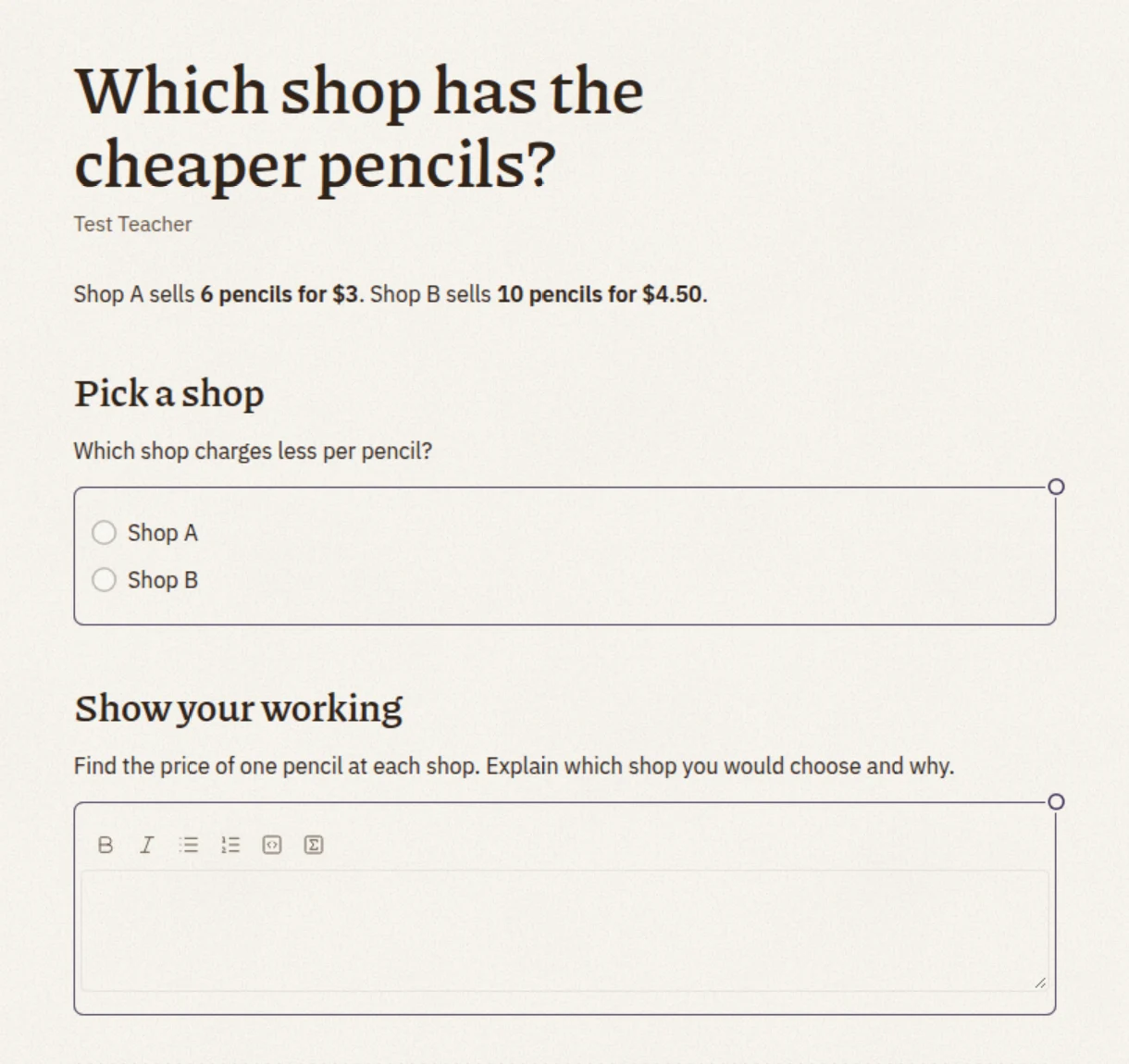
Complex multi-step reasoning suffers in card-based layouts. For example, in a math problem comparing
unit prices (Shop A selling 6 pencils for $3 versus Shop B selling 10 pencils for $4.50), students
need to calculate unit rates ($0.50 and $0.45 per pencil), select the cheaper shop, and write out
their working and rationale.
In Reparse, the entire problem lives on a unified page. The offers appear at the top, followed by a
choice selector, dedicated space for working out both calculations, and a written explanation box.
Beyond layout, Wayground restricts assignments to its fixed catalog of question types. If a tutor
wants students to test a physics simulation (such as varying masses to observe acceleration before
answering) or work through an interactive crossword for vocabulary, the platform cannot run custom
interactive code.
Reparse supports sandboxed custom elements. An assignment can combine standard questions with
custom code, whether written directly or drafted by an AI chat assistant. Students can interact
with runnable simulations, dynamic diagrams, or custom puzzles directly on the homework page
before writing their explanations.
The pencil-price homework as a student opens it: two offers, a choice, and open working space on a single page.
## Review: aggregate statistics versus rubric dialogue
Wayground provides automated grading for objective questions and generates class accuracy
percentages, question difficulty reports, and optional AI-generated commentary on open-ended
responses. However, communication is predominantly one-way: the student receives a score or
automated summary.
In tutoring and small-group instruction, feedback is an ongoing dialogue rather than a final score.
When a student makes a procedural error (such as dividing pencil count by price instead of price by
count), a numeric score or automated summary rarely clarifies the misunderstanding.
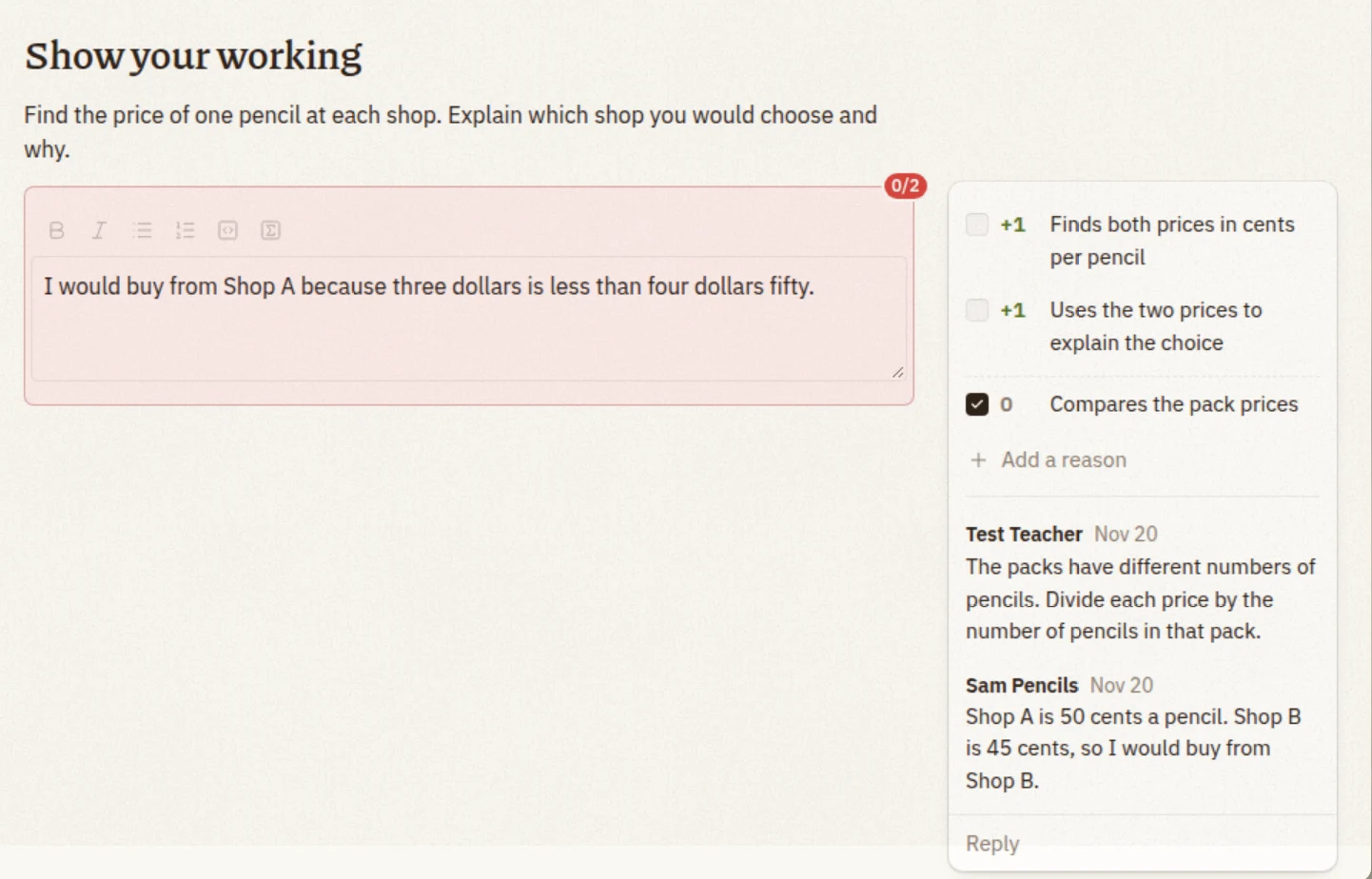
Reparse validates objective inputs (choices, blanks, ordering) against teacher-defined keys while
reserving written working for teacher evaluation. Teachers assess written steps against transparent
rubric criteria (such as one point for correct unit-price calculations and one point for logical
explanation).
Teachers can also attach targeted notes directly to the student's working. When work is returned,
the student reopens their homework link, reads the note directly beside their calculation, and can
post a reply in place to verify the correction.
The review interface displays the student's calculation beside the rubric criteria, the teacher's targeted note, and the student's reply in place.
## Student access and distractions
Wayground assignments typically require students to navigate via game PINs (`joinmyquiz.com`), login
prompts, or app installation recommendations. Free-tier sessions often display promotional banners
or links to other public quizzes that distract from the assignment.
Reparse homework is delivered as a clean, direct web link. Students open the page in any modern
browser without logins, account creation, or software downloads. The page contains only the assigned
homework, free from ads, recommended content, or game lobbies.
## Choosing between Wayground and Reparse
| Instructional capability | Wayground (Quizizz) | Reparse |
| :--- | :--- | :--- |
| Pacing model | Gamified timers, points, and speed multipliers | Untimed, self-paced deliberate practice |
| Layout architecture | Card-by-card question slides | Continuous single-page worksheet |
| Working space for multi-step tasks | Multiple-choice or short input cards | Dedicated open space for intermediate calculations |
| Interactive element support | Fixed vendor question catalog | Sandboxed custom elements (simulations, manipulatives, crosswords) |
| Review and evaluation | Aggregate accuracy stats and automated summaries | Question-level review with explicit rubric criteria |
| Feedback delivery | Static score notification | Threaded notes with in-place student replies |
| Student access | Room codes, game PINs, or account logins | Direct web link without student accounts or game lobbies |
Wayground is the right tool when:
- Running synchronous, multiplayer trivia games or review sessions in a live group setting.
- Practicing rapid factual recall where leaderboard energy and timers boost participation.
- Selecting pre-made question sets from an extensive public curriculum repository.
Reparse is the better choice when:
- Setting homework between lessons that requires multi-step calculations, written explanations, or
careful reading.
- Combining exercises with custom interactive tasks, such as runnable simulations or crosswords.
- Providing detailed teacher review with explicit rubrics and two-way feedback threads.
- Sharing assignments via direct, distraction-free links without student account requirements.
Make a homework in Reparse